
Education has always aspired to be the great equalizer—a path to opportunity accessible to all. Yet for many learners, traditional educational approaches have presented significant barriers. Students with disabilities, language learners, those with different learning styles, and those facing socioeconomic challenges have often found themselves navigating systems not designed with their needs in mind.
Artificial intelligence is changing this landscape in profound ways. Beyond its applications in content creation and assessment, AI is emerging as a powerful force for accessibility and inclusion in education. By adapting to individual needs, removing barriers to participation, and providing personalized support, AI tools are helping create learning environments where more students can thrive.
This article explores how AI is making education more accessible and inclusive across multiple dimensions. We’ll examine specific tools and approaches, share success stories from diverse educational settings, and provide practical guidance for educators looking to harness AI to better serve all learners. Whether you work with students with disabilities, English language learners, or simply diverse classrooms with varied needs, you’ll discover how AI can help create more equitable learning experiences.
Breaking Down Barriers for Students with Disabilities
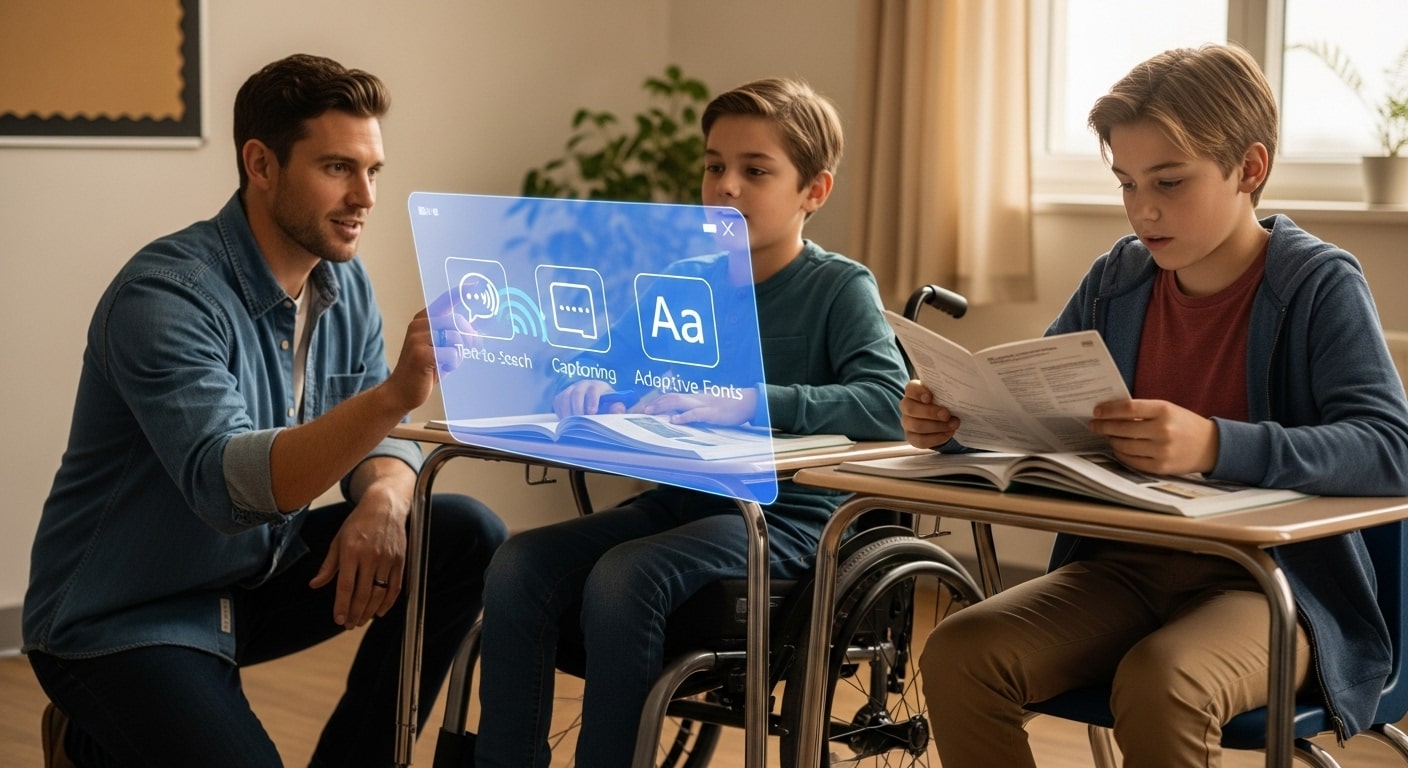
For students with disabilities, traditional educational materials and approaches can present significant barriers to learning. AI is helping dismantle these barriers through innovative tools and approaches that adapt to individual needs.
Text-to-Speech and Speech-to-Text Advancements
AI has dramatically improved text-to-speech and speech-to-text technologies, making them more natural, accurate, and contextually aware.
Speechify for Education has evolved from a simple text-to-speech tool to a comprehensive AI-powered reading assistant. The education version offers natural-sounding voices in multiple languages, adjustable reading speeds, and the ability to convert various document formats to audio. Its advanced neural voices sound remarkably human, making the listening experience more engaging for students who learn better through audio.
For students with dyslexia or visual impairments, tools like Speechify can transform any text—from textbooks to worksheets to online articles—into accessible audio content. The technology now recognizes context, adjusting tone and emphasis appropriately for questions, exclamations, or different types of content.
Similarly, Microsoft’s Immersive Reader has been enhanced with AI capabilities to make text more accessible. The tool now offers more sophisticated text simplification, advanced picture dictionary features, and improved translation options powered by neural machine translation. Its line focus and page color options help students with attention difficulties or visual processing challenges focus on content more effectively.
On the input side, speech-to-text technologies like Google’s Live Transcribe for Education now achieve near-human accuracy, allowing students with motor disabilities or writing difficulties to participate fully in writing assignments and assessments. The system can distinguish between speakers in classroom settings, filter out background noise, and even recognize subject-specific terminology when properly configured.
Visual Information Accessibility
For students with visual impairments, AI is transforming how visual information is made accessible.
Seeing AI for Education, developed by Microsoft, can describe images, read text, identify colors, and even recognize people in the classroom environment. When integrated into educational platforms, it can automatically generate alt text for images in learning materials, describe graphs and charts, and help visually impaired students navigate visual learning resources.
Diagram Center’s AI Description Tool specifically addresses the challenge of making complex visual information accessible. The tool can analyze diagrams, charts, maps, and other visual educational content, generating detailed descriptions that capture the essential information. For STEM education, where visual representations are often crucial, this tool helps ensure that visually impaired students can access the same conceptual understanding as their sighted peers.
Supporting Students with Autism and Attention Challenges
AI tools are also creating new possibilities for supporting students with autism spectrum disorders and attention challenges.
Hunu by Craft Education uses AI to offer personalized content, track developmental progress, and provide contextually relevant interventions for students with various learning challenges. For students with autism, the platform can provide social stories, visual schedules, and communication supports tailored to individual needs and preferences.
The platform’s adaptive interface can adjust to reduce sensory overload, presenting information in ways that align with the student’s processing style. For instance, it might reduce animations and background elements for students who are easily distracted or overwhelmed by visual stimuli.
For students with ADHD, Focus AI uses attention tracking and adaptive content presentation to help maintain engagement. The system can break content into manageable chunks, introduce timely breaks, and adjust the presentation based on attention patterns. When it detects attention drifting, it can modify the learning experience—perhaps introducing more interactive elements or suggesting a brief brain break—to help the student refocus.
Success Story: Inclusive Classrooms with AI Support
At Riverdale Elementary School in Portland, Oregon, special education teacher Maya Rodriguez has implemented a suite of AI accessibility tools in her inclusive classroom. “Before these tools, I was constantly creating different versions of materials for different students,” she explains. “Now, I can create one core lesson and the AI helps adapt it for each student’s needs.”
Rodriguez uses NotebookLM to organize her lesson content, then employs various accessibility tools to ensure all students can access the material. Students with reading difficulties use Speechify to listen to text, while those with writing challenges use speech-to-text tools to complete assignments. For students with autism who benefit from visual supports, AI-generated visual schedules and social stories help navigate the school day.
“The most remarkable change has been in student independence,” Rodriguez notes. “Instead of waiting for an adult to help them access content, students can use these tools to access information on their own terms. It’s empowering for them and allows me to focus on teaching rather than constantly adapting materials.”
Supporting Language Learners Through AI
Language barriers have traditionally presented significant challenges in education, whether for immigrant students learning the language of instruction or for students studying foreign languages. AI is creating new possibilities for language support that goes beyond simple translation.
Contextual Translation and Language Learning
AI-powered translation has evolved far beyond the word-for-word substitutions of early translation tools. Today’s neural machine translation systems understand context, idioms, and subject-specific terminology, making translations more accurate and natural.
Yeti Confetti combines human instruction with AI to provide simultaneous translation and culturally contextualized explanations of complex concepts. Originally implemented in schools in Lebanon and now gaining traction in diverse educational environments in the United States, this tool helps bridge language barriers and address cultural nuances in learning.
What makes Yeti Confetti particularly valuable is its understanding of educational contexts. When translating a math problem, for example, it recognizes mathematical notation and ensures that the translation preserves the problem’s structure and meaning. Similarly, when translating scientific concepts, it maintains technical terminology while making the surrounding explanation accessible.
For language learning itself, Duolingo Max incorporates advanced AI capabilities to create a more personalized and effective experience. The system uses generative AI to provide contextual explanations, simulate realistic conversations, and offer culturally nuanced feedback on language use. Unlike earlier language learning apps that relied on scripted interactions, Duolingo Max can engage in open-ended conversations about a wide range of topics, providing feedback on grammar, vocabulary, and cultural appropriateness.
Multilingual Content Creation and Adaptation
Beyond translation, AI is helping educators create and adapt content for multilingual classrooms.
Diffit’s Multilingual Module allows teachers to not only simplify text for different reading levels but also generate equivalent content in multiple languages. Rather than simply translating the original text, the system can create culturally relevant versions that maintain the core learning objectives while adapting examples and references to be meaningful in different cultural contexts.
For example, a lesson on fractions that uses pizza as an example in the English version might use different, culturally relevant food items in versions for other cultural contexts, ensuring that the concept is presented in a familiar and engaging way for all students.
MagicSchool.ai’s Multilingual Lesson Creator helps teachers develop lesson plans and materials that incorporate multiple languages strategically. The tool can suggest where and how to incorporate students’ home languages to support comprehension while still developing proficiency in the language of instruction. It can also generate bilingual vocabulary lists, reading guides, and assessment materials that help students connect concepts across languages.
Supporting Oral Language Development
For many language learners, developing speaking and listening skills presents particular challenges. AI tools are creating new opportunities for practice and feedback.
TalkPal AI provides personalized conversation practice for language learners, adapting to their proficiency level and learning goals. Unlike scripted dialogue practice, TalkPal can engage in authentic conversations about topics of interest to the student, adjusting its language complexity based on the student’s responses and providing gentle corrections when needed.
The system can simulate different accents and speaking styles, helping students develop listening comprehension for various contexts. It can also record and analyze student speech, providing feedback on pronunciation, grammar, and fluency in a supportive, non-judgmental way.
For younger language learners, StoryBuddy AI creates interactive storytelling experiences that support language development. The system can tell stories that incorporate the student’s interests, pause to ask comprehension questions, define unfamiliar words, and adjust language complexity based on the student’s responses. By engaging children in dialogue about the story, it helps develop both receptive and expressive language skills.
Success Story: Supporting Newcomer Students
At Washington High School in Chicago, ESL coordinator James Chen has implemented AI language tools to support a growing population of newcomer students from various countries. “We have students who speak twelve different languages,” Chen explains. “Before these AI tools, we struggled to provide adequate support in all these languages, especially for content-area subjects.”
Now, Chen and his colleagues use Yeti Confetti to provide real-time translation during lessons, while Diffit helps create multilingual materials for independent work. Students use TalkPal for conversation practice and Duolingo Max to develop their English skills outside of class.
“What’s been game-changing is the ability to provide content-area instruction while students are still developing English proficiency,” Chen notes. “A student who just arrived from Venezuela doesn’t have to wait to learn calculus or chemistry until her English is strong enough. She can access grade-level content in Spanish while simultaneously developing her English skills.”
The results have been impressive: newcomer students are maintaining academic progress in content areas while acquiring English more quickly than in traditional ESL programs. “These tools help us honor students’ existing knowledge and skills while supporting their language development,” Chen says. “It’s a more asset-based approach.”
Personalizing Learning for Diverse Needs
Beyond specific disability accommodations or language support, AI is enabling a broader personalization of education that benefits all learners. By adapting to different learning styles, paces, and interests, AI tools help create learning experiences that meet students where they are.
Adaptive Learning Platforms
Adaptive learning platforms use AI to continuously assess student understanding and adjust content accordingly, creating personalized learning paths.
Knewton Alta has evolved into a sophisticated adaptive learning system that goes beyond simply adjusting question difficulty. The platform now analyzes patterns in student responses to identify specific misconceptions or knowledge gaps, then provides targeted instruction and practice to address these areas. The system can recognize when a student is struggling with a particular concept and offer alternative explanations or approaches that might better match their learning style.
For younger learners, DreamBox Learning uses AI to adapt not just the difficulty but the entire presentation of mathematical concepts based on how students interact with the platform. If a student seems to learn better through visual representations, the system will emphasize visual approaches to new concepts. If another student shows strength in abstract reasoning, the system might introduce symbolic representations earlier.
Multimodal Content Presentation
AI is also enabling the automatic transformation of content into multiple formats to accommodate different learning preferences and needs.
Immersive Reader’s AI Enhancements now include the ability to automatically generate visual representations of concepts described in text. For example, when reading about photosynthesis, the system can create a visual diagram illustrating the process, helping visual learners grasp the concept more easily.
Pear Deck’s AI Presenter can transform lesson content into multiple formats simultaneously. As a teacher presents a lesson, the system can generate notes, visual summaries, and interactive questions that students can access based on their preferences. Visual learners might focus on the graphical representations, while others might prefer the text notes or interactive elements.
Interest-Based Learning Pathways
AI is also helping create more engaging learning experiences by connecting academic content to student interests.
Newsela AI has expanded beyond simply adjusting the reading level of news articles. The platform now uses AI to identify connections between current events and curriculum standards, helping teachers integrate relevant, engaging content into their lessons. The system can also identify articles that align with specific student interests while still addressing required learning standards, allowing for more personalized reading assignments.
Quest AI by Minecraft Education creates personalized learning quests that align curriculum objectives with student interests. The system can generate custom missions and challenges within the Minecraft environment that teach academic concepts through contexts that engage individual students. For a student interested in architecture, for example, the system might create challenges involving geometric principles applied to building design.
Success Story: Personalization at Scale
At Lincoln Middle School in Austin, Texas, principal Dr. Aisha Johnson implemented a school-wide approach to AI-supported personalization. “We wanted to move away from the one-size-fits-all model of education,” she explains, “but we needed to do it in a way that was sustainable for teachers.”
The school adopted a suite of adaptive learning platforms and AI tools that help teachers create and manage personalized learning experiences. Students have personalized learning plans that include a mix of adaptive software, teacher-led instruction, collaborative projects, and independent work.
“The AI tools handle much of the differentiation and progress monitoring,” Dr. Johnson notes, “which frees teachers to focus on building relationships, facilitating deeper learning experiences, and providing targeted support where it’s most needed.”
The school has seen significant improvements in both academic outcomes and student engagement since implementing this approach. “Students who previously struggled are finding success because they’re getting exactly what they need,” says Dr. Johnson. “And high-achieving students are able to move ahead without being held back by the pace of the whole class.”
Addressing Socioeconomic Barriers Through AI
Socioeconomic factors have long created inequities in educational access and outcomes. AI is helping address some of these barriers through innovative approaches that extend educational opportunities beyond traditional constraints.
Low-Bandwidth and Offline Solutions
For students with limited internet access, AI-powered tools that work with minimal connectivity are expanding access to quality educational experiences.
Musa’s WhatsApp Microlearning delivers AI-powered micro-learning through WhatsApp, a platform accessible on basic mobile phones with minimal data requirements. This innovative approach makes educational content available to students with limited internet access or devices.
The system uses AI to break down educational content into small, digestible chunks that can be delivered through text messages. It adapts to each student’s responses, providing personalized learning sequences that build over time. For students who can only connect to the internet occasionally, the system can send batches of content that can be accessed offline.
Kolibri AI enhances the Kolibri offline learning platform with AI capabilities that work entirely without internet connectivity. Once downloaded, the system can provide personalized learning experiences, adaptive assessments, and even limited content generation without requiring further online access. The AI models are compressed to run on low-powered devices, making them accessible even in resource-constrained environments.
Tutoring and Support Beyond School Hours
AI is also extending access to educational support beyond traditional school hours and settings.
Schoolhouse.world AI builds on Sal Khan’s tutoring platform by incorporating AI tutors that can provide 24/7 support for students. While human tutors remain central to the platform, AI tutors help address high-demand subjects and times when human tutors aren’t available. This ensures that students who need help with homework in the evening or early morning can still access support, regardless of their family’s ability to pay for private tutoring.
Paper’s AI Enhancement combines human tutoring with AI support to scale personalized academic help. The platform, which partners with school districts to provide free tutoring to students, uses AI to match students with appropriate tutors, suggest resources based on the questions being asked, and provide preliminary support while students wait to connect with a human tutor. This hybrid approach ensures that all students, regardless of family resources, can access academic support when they need it.
Bridging Resource Gaps
AI tools are also helping address resource disparities between schools and districts.
OpenStax AI enhances free, open educational resources with AI-powered features typically found in expensive commercial textbooks. The platform now includes adaptive quizzing, personalized study guides, and interactive simulations generated by AI, making high-quality learning materials available to all students regardless of their school’s budget for commercial resources.
Lab AI creates virtual science laboratory experiences that simulate experiments using AI. For schools with limited lab equipment or materials, these virtual labs provide opportunities for students to engage in scientific inquiry and develop laboratory skills. The AI can simulate various outcomes based on student choices, provide guidance on proper techniques, and even generate data for analysis when physical experimentation isn’t possible.
Success Story: Extending Opportunities in Rural Communities
In rural Appalachia, the Mountain View School District has leveraged AI tools to overcome geographic and economic isolation. “Our communities are spread across a large geographic area with limited resources,” explains technology coordinator Sarah Miller. “AI has helped us provide opportunities that would otherwise be inaccessible to our students.”
The district uses Kolibri AI on devices that students can take home, ensuring that learning can continue even without internet access. For high school students, Lab AI provides virtual science experiences that would be impossible with the district’s limited lab equipment. Schoolhouse.world AI and Paper provide tutoring support for students who live too far from school to participate in traditional after-school programs.
“What’s been most powerful is seeing students discover interests and talents they might never have explored without these tools,” Miller says. “We have students learning advanced mathematics, coding, and scientific concepts that we simply couldn’t offer before due to resource constraints.”
Implementing AI for Accessibility: Practical Guidance
For educators looking to harness AI to create more inclusive learning environments, here are practical steps to get started:
1. Audit Current Barriers and Needs
Begin by identifying the specific barriers that exist in your current educational context:
- Which students are struggling to access or engage with content?
- What accommodations are you currently providing manually?
- What needs remain unaddressed due to time or resource constraints?
- What feedback have students and families provided about accessibility challenges?
This audit will help you prioritize which AI tools to explore first based on your students’ most pressing needs.
2. Start with Universal Design for Learning (UDL) Principles
Universal Design for Learning provides a helpful framework for implementing AI accessibility tools. Consider how AI can support each of the three UDL principles:
Multiple Means of Engagement:
- How can AI help connect content to student interests?
- How can AI provide appropriate challenges for different learners?
- How can AI support student autonomy and self-regulation?
Multiple Means of Representation:
- How can AI present content in different formats (text, audio, visual)?
- How can AI adjust the complexity of content for different learners?
- How can AI provide support for comprehension across languages and backgrounds?
Multiple Means of Action and Expression:
- How can AI provide alternative ways for students to demonstrate knowledge?
- How can AI support executive functioning and organization?
- How can AI provide scaffolding that can be gradually removed as students develop skills?
3. Implement Strategically with Student Input
When implementing AI accessibility tools:
- Start with a small pilot focused on a specific need or group of students
- Involve students in the selection and implementation process
- Provide adequate training and support for both students and educators
- Establish clear protocols for when and how tools will be used
- Collect feedback regularly and adjust implementation accordingly
Remember that accessibility tools are most effective when students feel ownership and agency in their use.
4. Address Ethical Considerations Proactively
As you implement AI for accessibility, consider these ethical dimensions:
- Privacy: How is student data being collected, used, and protected?
- Equity: Are all students benefiting from these tools, not just those with identified needs?
- Independence: Are tools fostering genuine independence or creating new dependencies?
- Identity: How do these tools affect students’ sense of identity and belonging?
Engage in ongoing conversations with students, families, and colleagues about these considerations.
5. Measure Impact Holistically
When evaluating the impact of AI accessibility tools, look beyond academic metrics to consider:
- Student engagement and participation
- Independence and self-advocacy
- Confidence and self-efficacy
- Social inclusion and peer relationships
- Time saved for educators that can be redirected to high-value interactions
These holistic measures provide a more complete picture of how AI tools are affecting the educational experience.
The Future of AI Accessibility in Education
As AI continues to evolve, we can anticipate several promising developments in educational accessibility:
Multimodal AI Understanding and Generation
Future AI systems will become increasingly sophisticated at understanding and generating content across multiple modalities—text, speech, images, video, and interactive simulations. This will enable more seamless translation between formats, allowing students to access and create content in ways that best match their abilities and preferences.
Emotion-Aware Educational AI
Emerging AI systems are developing the ability to recognize emotional states through facial expressions, voice patterns, and interaction behaviors. When thoughtfully implemented with appropriate privacy protections, these systems could help identify when students are confused, frustrated, or disengaged, enabling more responsive support.
Brain-Computer Interfaces for Accessibility
For students with severe physical disabilities, brain-computer interfaces enhanced by AI are creating new possibilities for communication and participation. While still in early stages, these technologies hold promise for enabling students with limited motor control to interact with educational content through thought alone.
AI-Powered Accessibility Coaches
Future AI systems may serve as accessibility coaches, helping students develop self-advocacy skills and learn to use accessibility tools effectively. These AI coaches could help students identify which accommodations work best for them and how to request appropriate support in different contexts.
Conclusion: Toward Truly Inclusive Education
The promise of AI in education extends far beyond efficiency and automation. Perhaps its greatest potential lies in creating truly inclusive learning environments where every student can participate fully and learn effectively, regardless of disability, language background, learning style, or socioeconomic circumstances.
By breaking down barriers to access, personalizing learning experiences, and extending educational opportunities beyond traditional constraints, AI is helping realize the long-held ideal of education as the great equalizer. When thoughtfully implemented with a focus on equity and inclusion, these technologies can help create classrooms where diversity is not just accommodated but valued as a strength.
As educators, our role is to harness these powerful tools in service of our fundamental mission: helping every student discover and develop their unique potential. AI cannot replace the human connection, empathy, and wisdom at the heart of great teaching, but it can help us extend our reach and effectiveness in creating truly inclusive learning communities.
The future of education isn’t about choosing between human teachers and AI—it’s about discovering how these technologies can help us better fulfill our commitment to serving all learners. By embracing AI as a partner in this mission, we can move closer to the vision of education as a transformative force accessible to everyone.